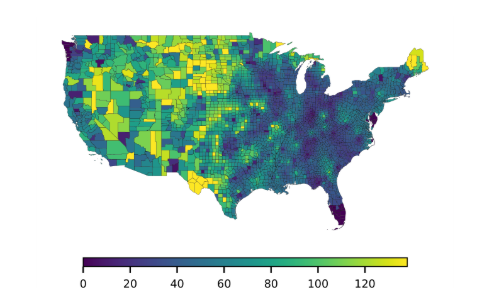
The TV White Space (TVWS) spectrum in the 470–608 MHz band travels far, penetrates well, and can cover large rural areas with modest infrastructure. The FCC authorized unlicensed secondary access more than a decade ago, yet rural deployments never took off, and the UK framework collapsed in 2024. With broadcast license renewals approaching (US 2028–2031, UK 2034) and 6G renewing the push to connect the unconnected, there is a narrow window to rethink how the band is governed. Across the country, the spectrum is broadly available and concentrated in rural areas. About 89.4% of US counties have at least one open channel, with a national median near 44 MHz per county. Tribal areas, among the most underserved, also skew toward high availability.
The harder problem is the gap between what the database reports and what the radio environment actually looks like. At ARA’s Agronomy Farm base station, the database reported three available channels while an RF sensor showed roughly 15 free at the site. That conservatism directly limits coverage. Running our TVWS massive MIMO system at 563 MHz on a channel we confirmed was empty, the database-mandated 16 dBm EIRP reached only 2–3 km, while 42 dBm EIRP extended coverage to 6–8 km at throughput near 120 Mbps. A 26 dB power restriction on empty spectrum cost an order of magnitude in covered area. Current rules also leave secondary users to interfere with one another, which we observed when two ARA base stations transmitted on the same database-reported channel.
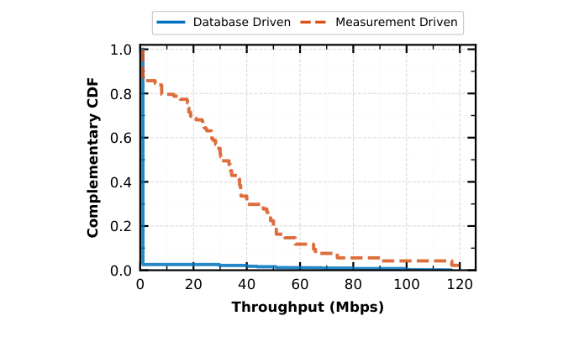
We trained a Physics-Informed Neural Network on 39 spatial samples across a 516 square mile area (RMSE 1.3 dBm) and used the resulting Radio Environment Maps to select channels for maximum coverage, while still validating incumbent protection against measured interference. Measurement-driven sharing delivers usable throughput across a far larger fraction of the region than the database-driven approach. On the policy side, we argue the FCC and NTIA should recognize the 470–608 MHz band as a strategic rural broadband resource and modernize Part 15 from fixed protection contours toward a dynamic, risk-informed framework that integrates near-real-time sensing.
The county-level dataset used in this study is openly available on IEEE DataPort: TVWS Spectrum Availability. Check the full paper here.