Revisiting TV White Space for Rural Broadband: Nationwide Availability and ARA Field Validation

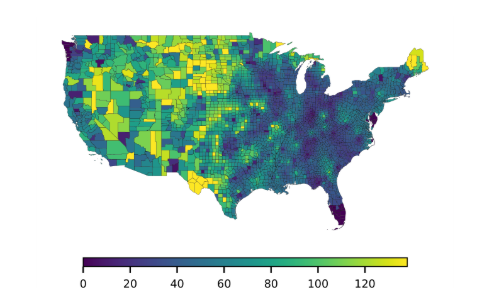
The TV White Space (TVWS) spectrum in the 470–608 MHz band travels far, penetrates well, and can cover large rural areas with modest infrastructure. The FCC authorized unlicensed secondary access more than a decade ago, yet rural deployments never took off, and the UK framework collapsed in 2024. With broadcast license renewals approaching (US 2028–2031, UK 2034) and 6G renewing the push to connect the unconnected, there is a narrow window to rethink how the band is governed. Across the country, the spectrum is broadly available and concentrated in rural areas. About 89.4% of US counties have at least one open channel, with a national median near 44 MHz per county. Tribal areas, among the most underserved, also skew toward high availability. 

The harder problem is the gap between what the database reports and what the radio environment actually looks like. At ARA’s Agronomy Farm base station, the database reported three available channels while an RF sensor showed roughly 15 free at the site. That conservatism directly limits coverage. Running our TVWS massive MIMO system at 563 MHz on a channel we confirmed was empty, the database-mandated 16 dBm EIRP reached only 2–3 km, while 42 dBm EIRP extended coverage to 6–8 km at throughput near 120 Mbps. A 26 dB power restriction on empty spectrum cost an order of magnitude in covered area. Current rules also leave secondary users to interfere with one another, which we observed when two ARA base stations transmitted on the same database-reported channel. 

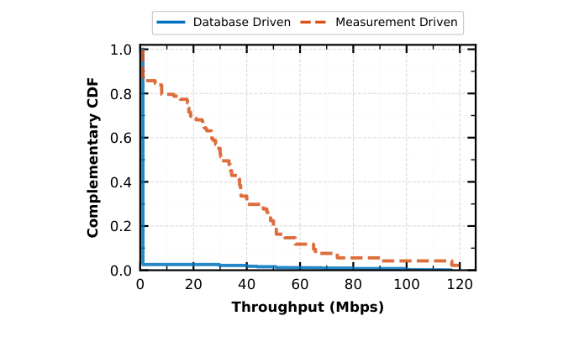
We trained a Physics-Informed Neural Network on 39 spatial samples across a 516 square mile area (RMSE 1.3 dBm) and used the resulting Radio Environment Maps to select channels for maximum coverage, while still validating incumbent protection against measured interference. Measurement-driven sharing delivers usable throughput across a far larger fraction of the region than the database-driven approach. On the policy side, we argue the FCC and NTIA should recognize the 470–608 MHz band as a strategic rural broadband resource and modernize Part 15 from fixed protection contours toward a dynamic, risk-informed framework that integrates near-real-time sensing. 

The county-level dataset used in this study is openly available on IEEE DataPort: TVWS Spectrum AvailabilityCheck the full paper here. 

Measurement Study of Dynamics and Liquid Data Transport in OneWeb LEO Satellite Networks

Authors: Evan Gossling, Owen Perrin, Daji Qiao, Hongwei Zhang

This work conducts a measurement study of the Eutelsat/OneWeb Low Earth Orbit (LEO) Satellite Network (LSN) using ARA’s backhaul OneWeb user terminal (UT). OneWeb has been an under-studied network, so we first conduct a measurement study of the OneWeb LSN from a user’s perspective, and then examine the potential benefits of liquid data transport to increase the reliability of LSNs, as some LSN deployments may observe up to 2% packet loss1.

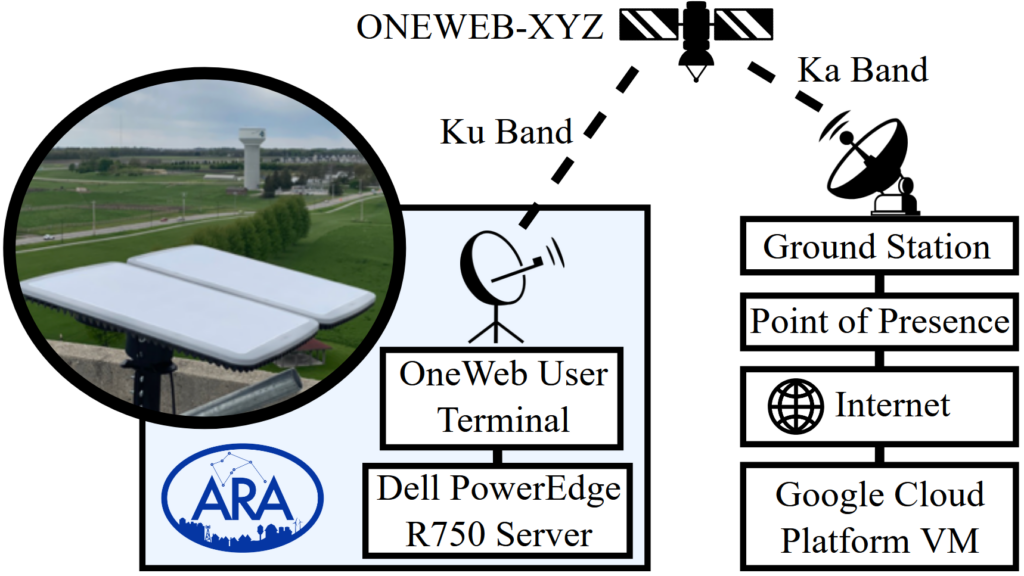
Our topology figure showcases ARA’s backhaul UT deployed on the rooftop of Iowa State University’s Wilson Residence Hall. Through ARA’s online portal1, we can run experiments from a Dell PowerEdge server directly attached to the OneWeb indoor unit (IDU). Additionally, we utilize a virtual machine (VM) from the Google Cloud Platform near Ashburn, Virginia.

The UT connects via the Ku band to the OneWeb satellite constellation. The connected satellite then connects back to OneWeb ground stations via the Ka band in a bentpipe fashion. These ground stations transmit to and from OneWeb points of presence (PoPs), which are larger data centers where traffic within the OneWeb network is peered with the wider Internet. The service-level agreement (SLA) for ARA’s OneWeb connection is 100 Mbps downlink and 20 Mbps uplink.

We experiment with liquid data transport over our existing OneWeb LSN and deploy both endpoints of the transport in our architecture between the ARA server on ISU campus in Ames, Iowa, and the Google Cloud VM at Ashburn, Virginia.

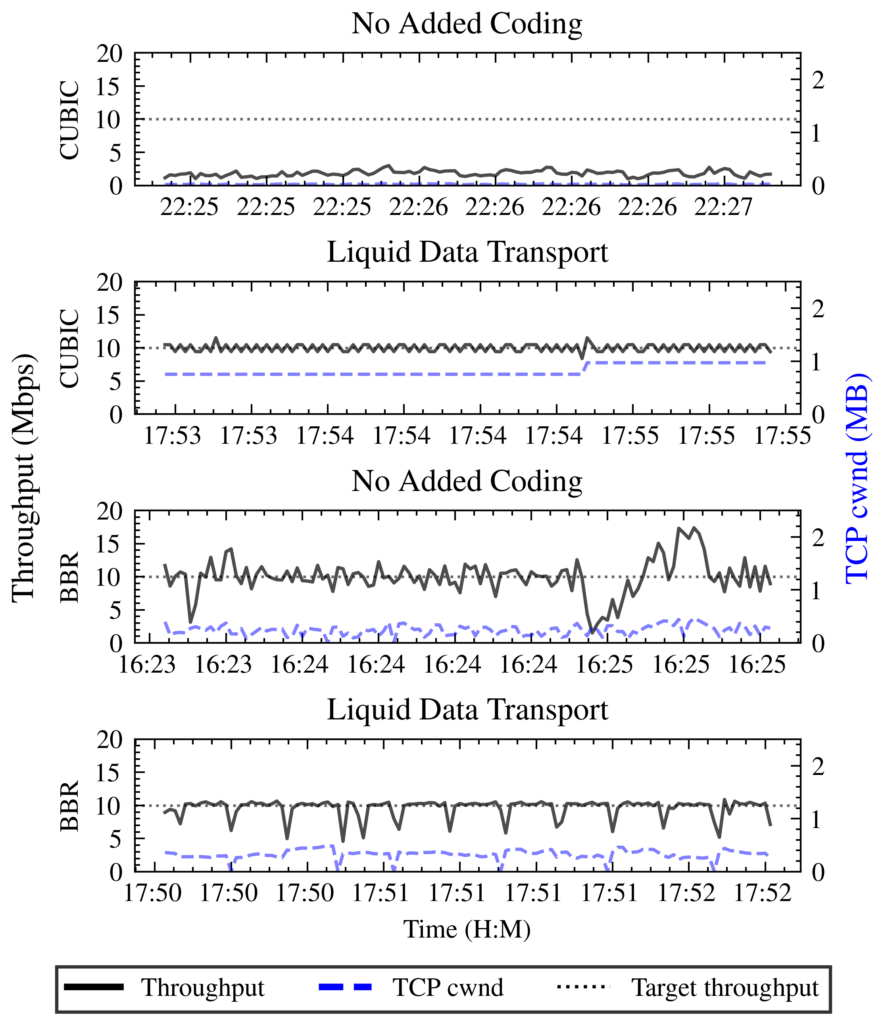
We examine the statistical performance of liquid data transport in comparison to the baseline transport of TCP with no added coding scheme (aside from any coding which OneWeb may internally utilize). Our results figure compares the performance of liquid data with that of un-encoded TCP with BBR and CUBIC congestion control algorithms. We examine a time series of transferring data at a target rate of 10 Mbps over the LSN, which is subject to an artificial loss rate of 1%.

This additive 1% loss is used to demonstrate the effectiveness of liquid data in instances where the LSN drops packets, as is possible with LSNs such as Starlink, and to a certain extent, OneWeb. Overcoming this packet loss is important due to the network requirements of real-time applications, of which such applications will incur performance degradation when retransmissions must be made, which is exasperated when using an LSN.

Our figure shows that the performance of CUBIC increases significantly when liquid data transport is utilized compared to without it. To better understand this, we can further analyze the cwnd shown in the figure. As we can see, the cwnd value never increases to a suitable quantity for CUBIC (with no coding) when consistent losses are experienced. Essentially, these loss-based congestion control mechanisms prevent any substantial growth of the cwnd. On the other hand, when a tunnel is established between the TCP sender and receiver by the liquid data transport, packet losses are overcome inside the tunnel using the redundant repair data generated by the erasure code, thus shielding the TCP endpoints. As a result, the cwnd remains around a constant high value that corresponds to the target data rate of 10 Mbps.

BBR’s performance is comparatively similar in both cases as BBR is a delay-based protocol and its model of the link is not drastically affected by these packet losses; not to the degree that CUBIC’s loss-based model is. However, as the loss rate increases, the amount of retransmissions BBR (with no coding) must make increases correspondingly2, whereas liquid data transport is able to overcome the packet loss without incurring additional retransmissions. For the traces shown in Fig. 9, BBR with no coding incurs 1767 retransmissions throughout the trace to transmit the application data, while BBR with liquid data transport only experiences 81 retransmissions.

Using liquid data transport, packet losses are shielded from the TCP endpoints where the congestion control algorithm is executed. It also eliminates or significantly reduces the amount of packet retransmissions. Both factors allow for natural growth and steady-state moderation of the cwnd size, which, in turn, results in increased and stable throughput. Overall, we find that OneWeb generally fulfills its service-level agreements, and liquid data transport may be used to further increase the reliability of TCP flows over LSNs.

Check the full article here.

[1] F. Michel, M. Trevisan, D. Giordano, and O. Bonaventure, “A first look at starlink performance,” in Proceedings of the 22nd ACM Internet Measurement Conference, 2022, pp. 130–136.
[2] Y. Cao, A. Jain, K. Sharma, A. Balasubramanian, and A. Gandhi, “When to use and when not to use bbr: An empirical analysis and evaluation study,” in Proceedings of the Internet Measurement Conference, 2019, pp. 130–136.
At-Scale, Real-World srsRAN Experiments in ARA

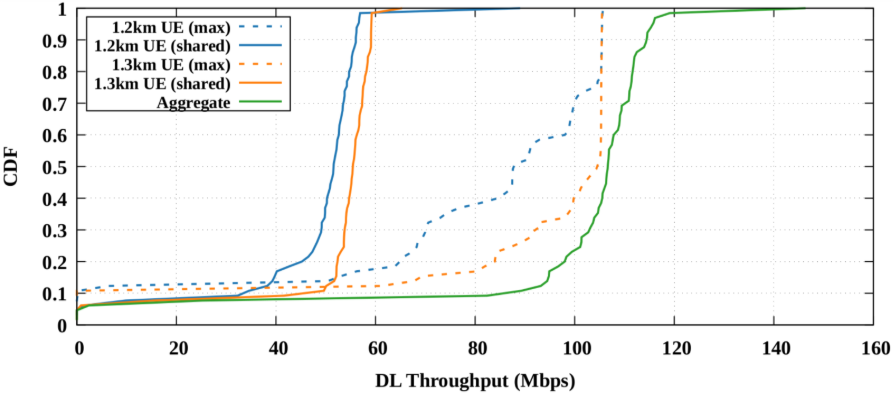
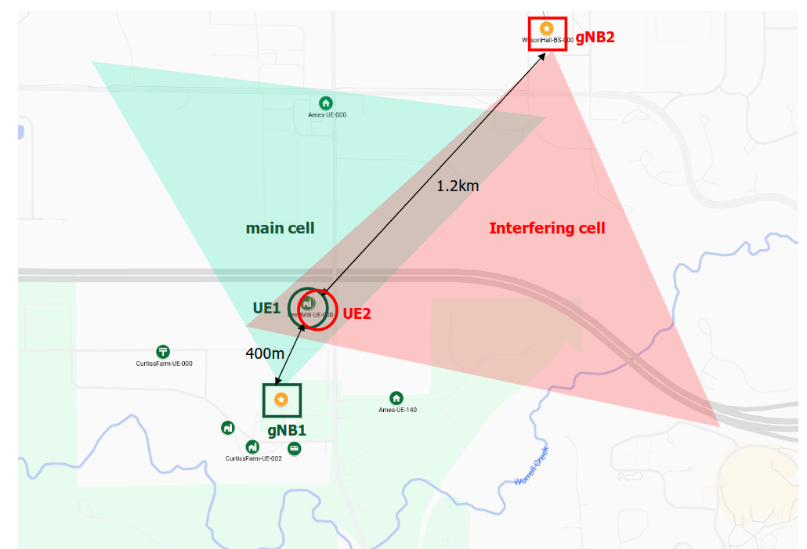
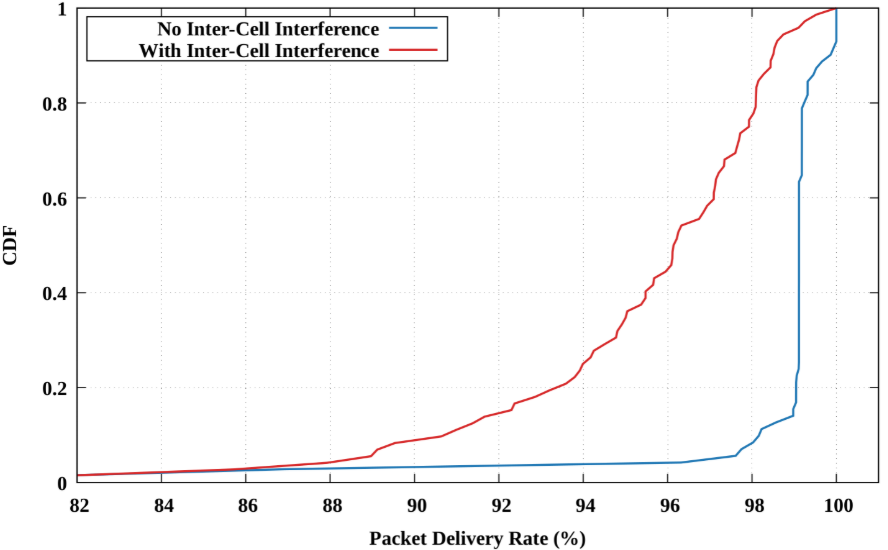
ARA is pleased to announce new long-range and field-validated open-source 5G and open RAN capabilities using srsRAN across rural and agricultural environments. This large-scale, outdoor deployment demonstrates stable, reliable and high-throughput connectivity using programmable base stations and commercial-off-the-shelf (COTS) UEs. Leveraging high-power and low-noise amplifiers at the programmable base stations, ARA now supports over-the-air coverage up to 1.3km using NI N320 software-defined radios and Quectel RM500Q-GL UEs. Recent outdoor trials demonstrate stable attachment, high throughput, and robust link reliability, even in complex terrains such as valleys and cell edges—showcasing ARA’s ability to expose rich propagation diversity and realistic interference dynamics. Single-cell results shown in Figure 1 confirm strong throughput  scaling with distance and terrain, while multi-cell trials reveal predictable patterns of throughput, latency, and jitter. Figure 3 shows reliability in terms of packet delivery rate in multi-cell interference scenarios. The setup for the results presented in Figure 3 is illustrated in Figure 2. These characteristics make ARA uniquely suited for benchmarking, optimization, and future 6G and Open RAN research in real-world conditions. 

Beyond connectivity, ARA’s srsRAN deployment enables end-to-end measurement, prototyping, and multi-cell experimentation across distributed UE sites and multi-sector gNBs. Researchers can capture per-UE and per-packet metrics—such as throughput, packet delivery reliability, latency, jitter, and interference effects at kilometer-scale ranges. The ARA platform thus enables rigorous exploration of URLLC, HRLLC, multi-UE contention, rural macro-cell behavior and interference modeling under rich outdoor channel conditions leveraging srsRAN software stack. With such capabilities, ARA is well positioned as one of the few living labs to directly support the mission of the Linux Foundation Open Centralized Unit Distributed Unit  (OCUDU) initiative by providing a  large-scale, field-deployed and fully programmable open RAN platform that accelerates open-source ecosystem adoption, reduces reliance on proprietary infrastructure, and enables rigorous next-generation wireless research and prototyping in strategic agricultural and rural settings. Example experiments can be conducted by following the detailed ARA user manual

Figure 1: Multi-UE downlink throughput
Figure 2: Multi-Cell deployment scenario 
Figure 3: Packet delivery rate in multi-cell interference scenarios

ARA December 2025 Newsletter Is Now Live!

We’re excited to share that the December 2025 ARA Newsletter is now available! This edition highlights ARA milestones, community insights, and the newest capabilities unlocked through the ARA wireless living lab. Highlights of this edition include:

  • Join us in September 2026 for AraFest 26! Co-located with the 2026 Farm Progress Show, AraFest’26 will showcase breakthroughs in advanced wireless technologies. Please join us to co-shape AraFest’26. Talks, panels, and demos are all welcome!  
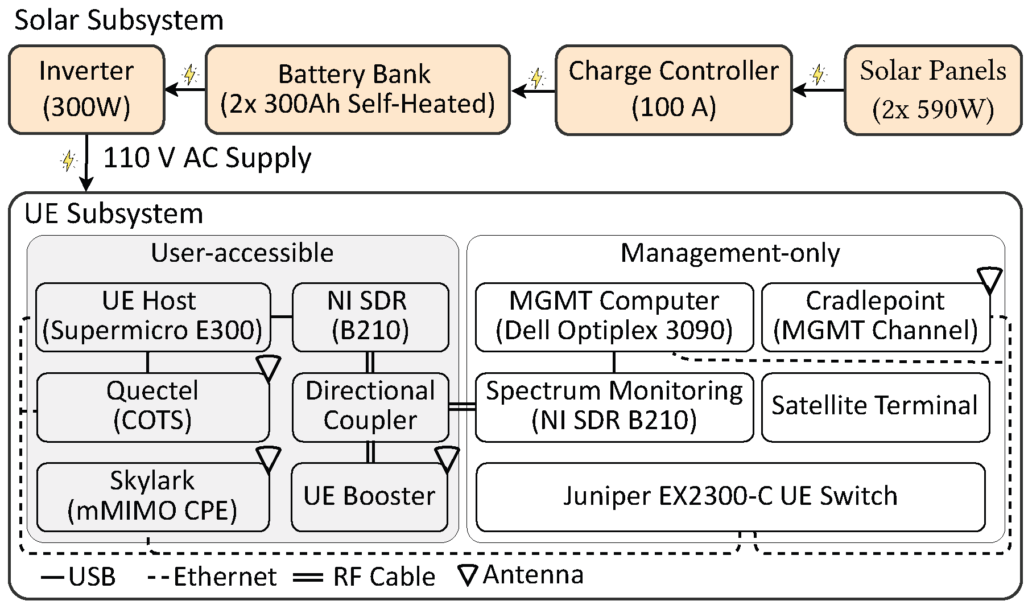
  • ARA capability update: A Starlink terminal has been installed next to the OneWeb user terminal. More experiments are supported by ARA , such as outdoor srsRAN experiments and OAI experiments at new outdoor sites.
  • User stories of how ARA can be used for 1) field scouting acceleration in precision agriculture and 2) random access reliability enhancement for NextG. 

“Amiga”: Accelerating Field Scouting with ARA’s FutureG Connectivity 

In the AIIRA national AI institute, Prof. Soumik Sarkar (Mechanical Engineering) and Prof. Asheesh “Danny” Singh (Agronomy) at Iowa State University leverages ARA to investigate how networked agricultural ground vehicles, remote sensing and computing, and machine learning can automate labor-intensive field scouting—transforming hours of manual assessment into near-real-time analysis and decision-making.

Traditional field scouting and crop phenotyping are both time-consuming and labor-intensive. To address this challenge, the team is developing an integrated platform (shown in the picture below) that combines a highly customized, field-deployable “Amiga” platform (Bonsai Robotics, San Jose, CA), which can be equipped with a wide range of sensors such as high-resolution imaging sensors, with an automated navigation system, an ARA communication user endpoint, and a high-performance computing unit. Together, these components enable automated data collection, fast model training, and data-driven actuation decisions directly in the field.

The ARA wireless living lab plays a key role in this initiative. The custom ARA communication endpoint developed for the Amiga robot delivers the throughput, coverage, reliability, and low latency needed for real-time video streaming, data collection, and edge inference, which is in sharp contrast to the unstable and intermittent connectivity commonly experienced in rural farm fields today. Joscif Raigne, a PhD student who manages and operates the Amiga experimental platform, shared his enthusiasm: “The sky is the limit for agricultural applications when unmanned vehicles, field sensors, and computing servers are interconnected through next-generation, reliable, high-performance networks.” 

The Amiga platform was featured as a plenary demo at AraFest’24. Videos of the presentation and demonstration can be found here. Currently, the team is expanding the pilot to include other types of unmanned agricultural vehicles, such as scouting drones and sprayer drones, for precision weed control and other farm applications.