At the University of Iowa, Prof. Tianyu Zhang and his research group are leveraging the ARA wireless living lab to advance research on real-time 5G networking while bringing hands-on wireless experimentation into the classroom. ARA has served two important roles: providing an experimental environment to validate research findings beyond the group’s local testbed, and making real 5G experimentation accessible to undergraduate and graduate students.
Research: Unlike conventional networking applications that primarily focus on throughput or average latency, real-time applications require packets to meet strict deadlines. Missing a deadline may lead to incorrect or unsafe system behavior. One challenge that has received relatively little attention is the heterogeneity of user equipment (UEs) in industrial 5G systems. A smart factory may contain high-end 5G gateways, autonomous vehicles, industrial controllers, and low-power sensors, all with different radio bandwidth capabilities. How can these heterogeneous devices share a wideband 5G network while still satisfying their real-time communication requirements?
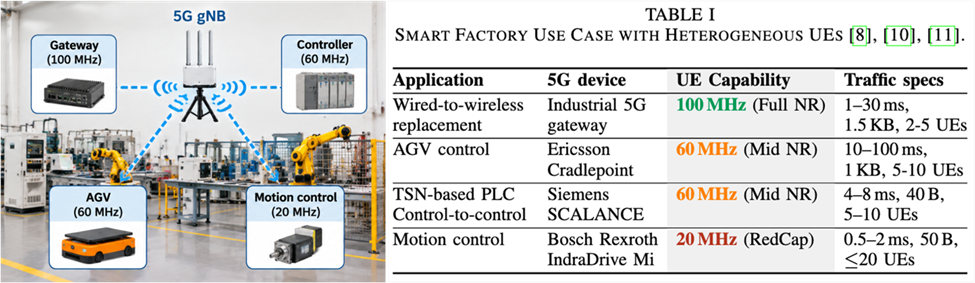
To investigate this problem, Zhang’s group built an OAI-based 5G testbed using SDRs and commercial devices, e.g., Quectel 5G modem. The experiments confirmed that a bandwidth-limited UE may fail to connect to a 5G carrier wider than its supported bandwidth. By configuring a narrower BWP, the same UE can successfully connect to the wider carrier. The measurements also confirmed that BWP constrains the radio resources available to a UE, making it a useful mechanism for resource allocation and scheduling. ARA played an important role in extending these experiments beyond the local laboratory. Using ARA’s programmable SDR infrastructure and OAI environment, the researchers reproduced the bandwidth-capability mismatch on a different experimental platform. Although the failure behavior differed due to the OAI software environment, the underlying hardware-capability constraint remained consistent.
This cross-validation strengthened the experimental evidence and helped establish the practical basis for the group’s BWP-aware real-time scheduling framework. The resulting work, BWP-Aware Real-Time Scheduling for Heterogeneous UEs in Industrial 5G Systems, was accepted at the 2026 IEEE Real-Time Systems Symposium (RTSS). This experience demonstrates how ARA can help researchers connect analytical networking models with real-system behavior, particularly when experimental results need to be verified across different hardware and software environments.
Education: Beyond research, ARA has also become a valuable educational resource for students at the University of Iowa. Zhang teaches a Mobile Computing course attended by both undergraduate and graduate students. The course introduces modern wireless networking technologies, including 5G, and requires students to complete a course project.
Many students are interested in 5G and want to go beyond learning its theoretical concepts or running simulations. They want to work with actual 5G systems, configure network parameters, and observe how communication technologies perform in practice. However, the number of SDR devices available in a university laboratory is often limited, making it difficult to accommodate multiple undergraduate and graduate course projects simultaneously.
ARA has helped overcome this resource limitation. Several students in the Mobile Computing course have already used ARA to carry out their final course projects, gaining hands-on experience with real 5G experimentation rather than relying solely on theoretical analysis or simulation. ARA’s remotely accessible experimental infrastructure allows students to conduct wireless experiments without requiring dedicated 5G equipment in their own laboratory. Its programmable SDR resources and support for open-source 5G platforms provide a practical environment for exploring cellular networking technologies.
The University of Iowa experience illustrates how ARA’s shared infrastructure can support not only research-intensive projects but also broader hands-on education, giving more students opportunities to explore next-generation wireless technologies.
Authors: Tianyu Zhang, Subasree Balamurali, Mainak Mondal, X. Sharon Hu, Song Han