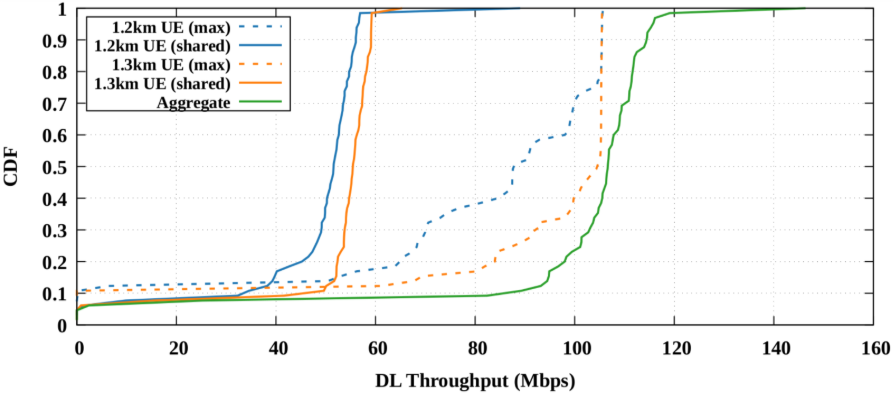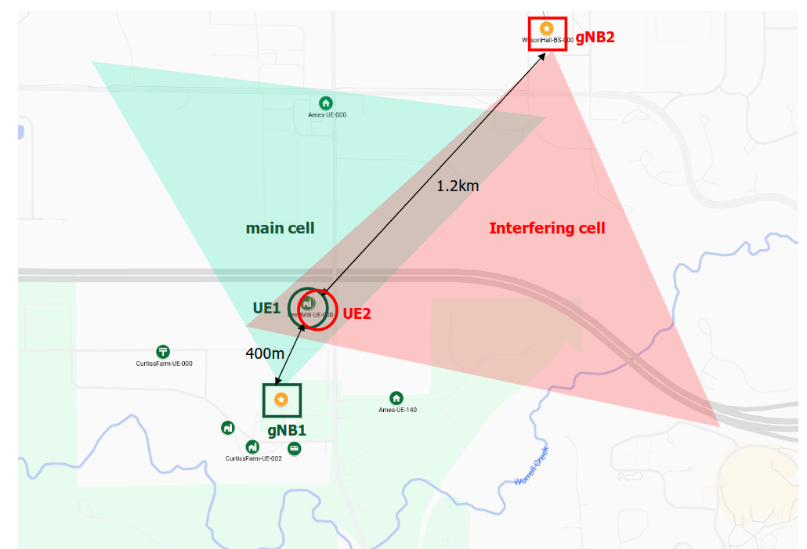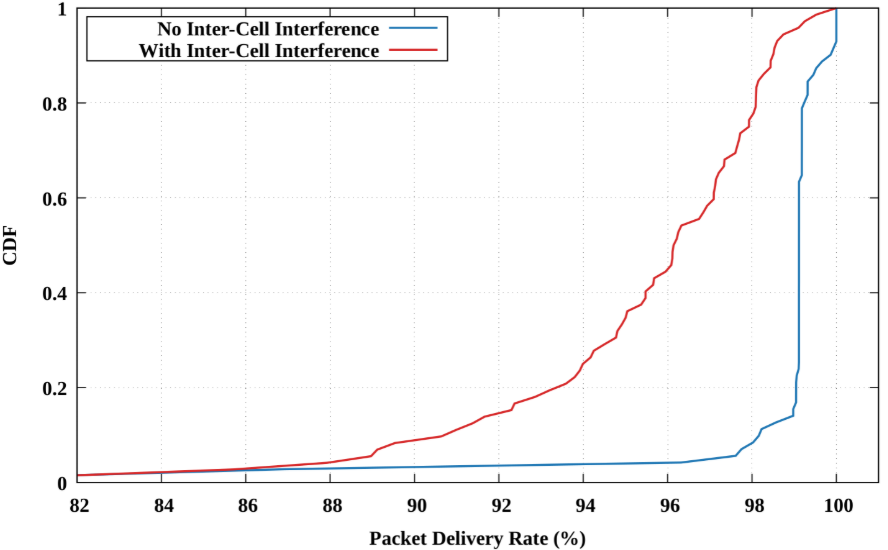
ARA is pleased to announce new long-range and field-validated open-source 5G and open RAN capabilities using srsRAN across rural and agricultural environments. This large-scale, outdoor deployment demonstrates stable, reliable and high-throughput connectivity using programmable base stations and commercial-off-the-shelf (COTS) UEs. Leveraging high-power and low-noise amplifiers at the programmable base stations, ARA now supports over-the-air coverage up to 1.3km using NI N320 software-defined radios and Quectel RM500Q-GL UEs. Recent outdoor trials demonstrate stable attachment, high throughput, and robust link reliability, even in complex terrains such as valleys and cell edges—showcasing ARA’s ability to expose rich propagation diversity and realistic interference dynamics. Single-cell results shown in Figure 1 confirm strong throughput scaling with distance and terrain, while multi-cell trials reveal predictable patterns of throughput, latency, and jitter. Figure 3 shows reliability in terms of packet delivery rate in multi-cell interference scenarios. The setup for the results presented in Figure 3 is illustrated in Figure 2. These characteristics make ARA uniquely suited for benchmarking, optimization, and future 6G and Open RAN research in real-world conditions.
Beyond connectivity, ARA’s srsRAN deployment enables end-to-end measurement, prototyping, and multi-cell experimentation across distributed UE sites and multi-sector gNBs. Researchers can capture per-UE and per-packet metrics—such as throughput, packet delivery reliability, latency, jitter, and interference effects at kilometer-scale ranges. The ARA platform thus enables rigorous exploration of URLLC, HRLLC, multi-UE contention, rural macro-cell behavior and interference modeling under rich outdoor channel conditions leveraging srsRAN software stack. With such capabilities, ARA is well positioned as one of the few living labs to directly support the mission of the Linux Foundation Open Centralized Unit Distributed Unit (OCUDU) initiative by providing a large-scale, field-deployed and fully programmable open RAN platform that accelerates open-source ecosystem adoption, reduces reliance on proprietary infrastructure, and enables rigorous next-generation wireless research and prototyping in strategic agricultural and rural settings. Example experiments can be conducted by following the detailed ARA user manual.