
Authors: Evan Gossling, Owen Perrin, Daji Qiao, Hongwei Zhang
This work conducts a measurement study of the Eutelsat/OneWeb Low Earth Orbit (LEO) Satellite Network (LSN) using ARA’s backhaul OneWeb user terminal (UT). OneWeb has been an under-studied network, so we first conduct a measurement study of the OneWeb LSN from a user’s perspective, and then examine the potential benefits of liquid data transport to increase the reliability of LSNs, as some LSN deployments may observe up to 2% packet loss1.
Our topology figure showcases ARA’s backhaul UT deployed on the rooftop of Iowa State University’s Wilson Residence Hall. Through ARA’s online portal1, we can run experiments from a Dell PowerEdge server directly attached to the OneWeb indoor unit (IDU). Additionally, we utilize a virtual machine (VM) from the Google Cloud Platform near Ashburn, Virginia.
The UT connects via the Ku band to the OneWeb satellite constellation. The connected satellite then connects back to OneWeb ground stations via the Ka band in a bentpipe fashion. These ground stations transmit to and from OneWeb points of presence (PoPs), which are larger data centers where traffic within the OneWeb network is peered with the wider Internet. The service-level agreement (SLA) for ARA’s OneWeb connection is 100 Mbps downlink and 20 Mbps uplink.
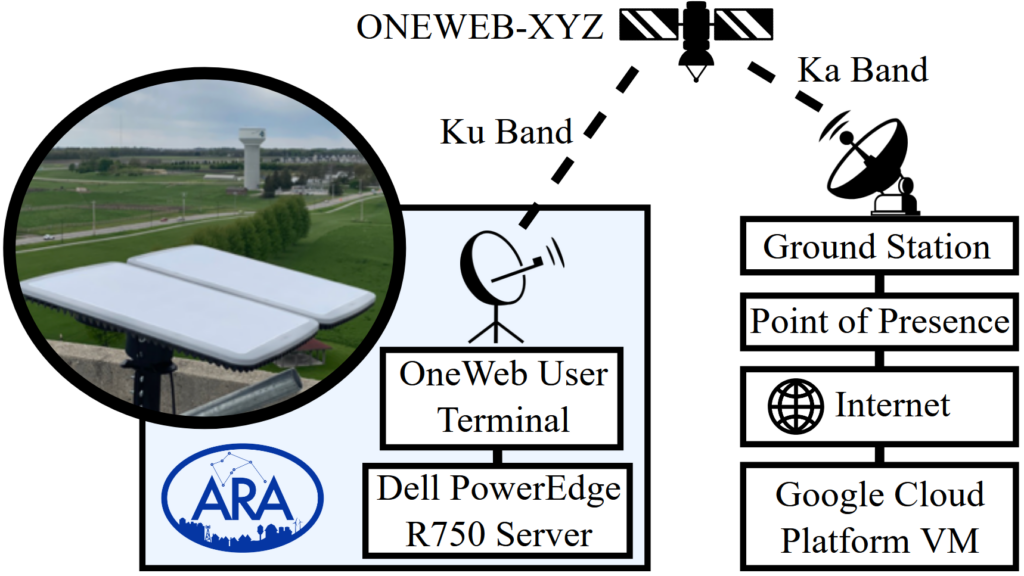
We experiment with liquid data transport over our existing OneWeb LSN and deploy both endpoints of the transport in our architecture between the ARA server on ISU campus in Ames, Iowa, and the Google Cloud VM at Ashburn, Virginia.
We examine the statistical performance of liquid data transport in comparison to the baseline transport of TCP with no added coding scheme (aside from any coding which OneWeb may internally utilize). Our results figure compares the performance of liquid data with that of un-encoded TCP with BBR and CUBIC congestion control algorithms. We examine a time series of transferring data at a target rate of 10 Mbps over the LSN, which is subject to an artificial loss rate of 1%.
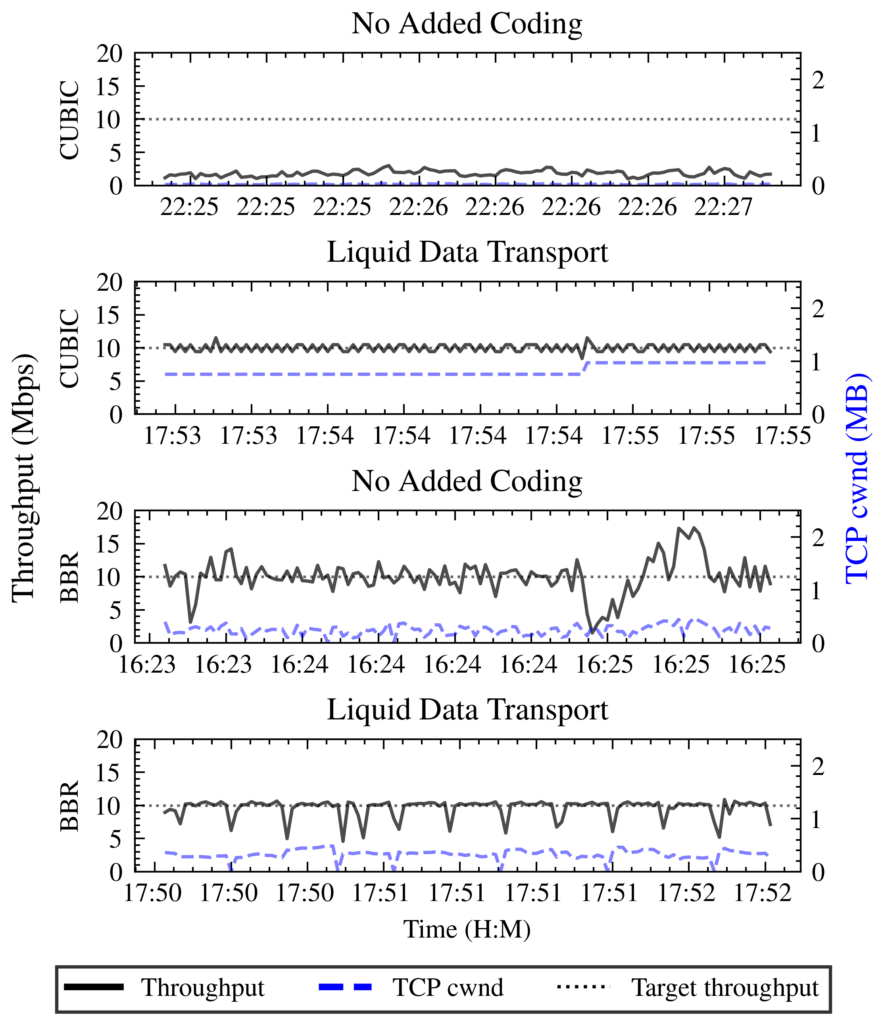
This additive 1% loss is used to demonstrate the effectiveness of liquid data in instances where the LSN drops packets, as is possible with LSNs such as Starlink, and to a certain extent, OneWeb. Overcoming this packet loss is important due to the network requirements of real-time applications, of which such applications will incur performance degradation when retransmissions must be made, which is exasperated when using an LSN.
Our figure shows that the performance of CUBIC increases significantly when liquid data transport is utilized compared to without it. To better understand this, we can further analyze the cwnd shown in the figure. As we can see, the cwnd value never increases to a suitable quantity for CUBIC (with no coding) when consistent losses are experienced. Essentially, these loss-based congestion control mechanisms prevent any substantial growth of the cwnd. On the other hand, when a tunnel is established between the TCP sender and receiver by the liquid data transport, packet losses are overcome inside the tunnel using the redundant repair data generated by the erasure code, thus shielding the TCP endpoints. As a result, the cwnd remains around a constant high value that corresponds to the target data rate of 10 Mbps.
BBR’s performance is comparatively similar in both cases as BBR is a delay-based protocol and its model of the link is not drastically affected by these packet losses; not to the degree that CUBIC’s loss-based model is. However, as the loss rate increases, the amount of retransmissions BBR (with no coding) must make increases correspondingly2, whereas liquid data transport is able to overcome the packet loss without incurring additional retransmissions. For the traces shown in Fig. 9, BBR with no coding incurs 1767 retransmissions throughout the trace to transmit the application data, while BBR with liquid data transport only experiences 81 retransmissions.
Using liquid data transport, packet losses are shielded from the TCP endpoints where the congestion control algorithm is executed. It also eliminates or significantly reduces the amount of packet retransmissions. Both factors allow for natural growth and steady-state moderation of the cwnd size, which, in turn, results in increased and stable throughput. Overall, we find that OneWeb generally fulfills its service-level agreements, and liquid data transport may be used to further increase the reliability of TCP flows over LSNs.
Check the full article here.
[1] F. Michel, M. Trevisan, D. Giordano, and O. Bonaventure, “A first look at starlink performance,” in Proceedings of the 22nd ACM Internet Measurement Conference, 2022, pp. 130–136.
[2] Y. Cao, A. Jain, K. Sharma, A. Balasubramanian, and A. Gandhi, “When to use and when not to use bbr: An empirical analysis and evaluation study,” in Proceedings of the Internet Measurement Conference, 2019, pp. 130–136.