
Modern agricultural AI relies on timely, high-quality field data. Yet collecting and processing this data in real time, especially in rural environments, remains a critical challenge. The ARA-to-ICICLE pipeline addresses this gap by enabling live agricultural data streaming from remote locations directly into an AI processing pipeline, unlocking faster insights and more responsive, data-driven farming.
This collaboration between the ARA project at Iowa State University, ICICLE at The Ohio State University, and the San Diego Supercomputer Center combines expertise in wireless networking, distributed systems, and AI-driven agricultural analytics, demonstrating how cross-disciplinary innovation can transform farming operations.
From a Soybean Field in Iowa to an AI Pipeline in Ohio
Our demonstration focuses on a practical use case: monitoring a remote soybean field in Ames, Iowa, located at Iowa State University’s Agronomy Farm. A drone equipped with ARA wireless capabilities flies over the field, capturing high-resolution live video. Instead of storing the data for later analysis, the video is streamed in real time to the ICICLE AI pipeline at The Ohio State University, enabling immediate preprocessing and analysis. The live stream is broken into individual frames, geo-tagged, and processed for AI-driven tasks such as weed detection, allowing actionable insights to be generated in near real time.
ARA Wireless: Enabling Edge Connectivity in Rural Environments
This demonstration is built around the ARA wireless network, which provides the connectivity between the field-deployed drone and downstream computing infrastructure, as illustrated in the figure below.. The drone carries an ARA User Equipment (UE) payload, consisting of an onboard compute node (Raspberry Pi 5 16GB RAM), a high-resolution camera (Arducam OwlSight 64 MP Auto Focus), and a cellular wireless module (Quectel RG530). As the drone flies over the soybean field, it connects to a nearby ARA base station and continuously streams video to the ARA Data Center through ARA x-haul links.
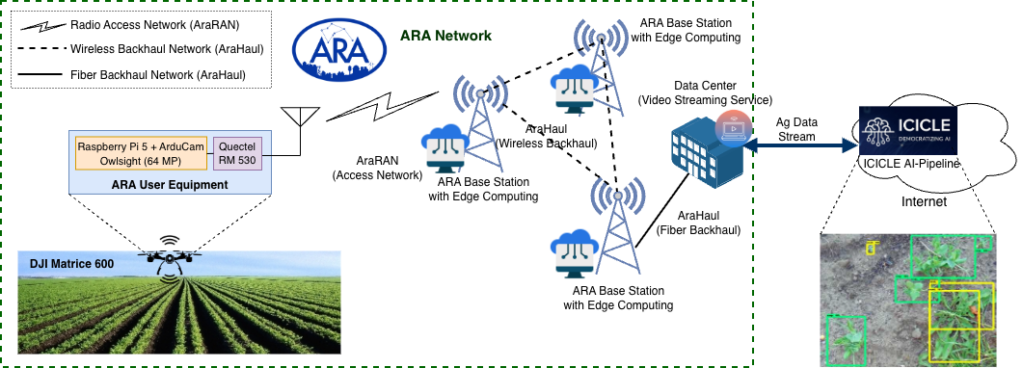
Rural deployments present unique challenges: unlike urban areas, base stations are often not connected by optical fiber. ARA addresses this limitation by providing long-range, high-capacity wireless backhaul (shown as AraHaul (Wireless Backhaul) in the figure above), leveraging technologies such as millimeter-wave, microwave, and free-space optical communication. This approach demonstrates that even fiber-scarce rural areas can be fully integrated into high-throughput AI pipelines, enabling real-time agricultural insights anywhere.
At the ARA Data Center, a dedicated video streaming server receives the incoming feed. ICICLE then retrieves the stream directly from this server for further processing and analysis.
ICICLE: Turning Remote Data into Actionable Insights
Once the video reaches ICICLE, the system generates individual frames from the live stream and geo-tags them using metadata embedded in the video. These processed frames are then fed into the ICICLE AI pipeline.
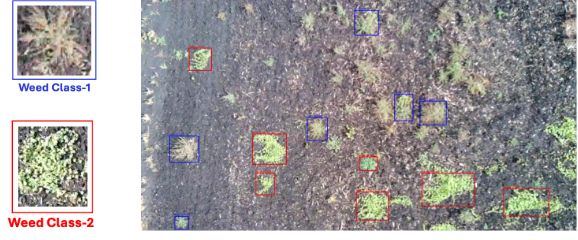
In our demo, we focus on weed detection, considering two weed classes. The AI engine analyzes the incoming frames and identifies weed regions, visually highlighting detected weeds for each class. Snapshots of weed detection results at ICICLE are shown in the figure below. This end-to-end workflow, from drone-based sensing to AI inference, demonstrates how remote agricultural environments can be tightly integrated with modern AI systems.
Impact and Future Directions: Wireless and Agricultural Innovation Together
The ARA-to-ICICLE pipeline exemplifies a scalable, flexible framework for remote data sourcing in agriculture, providing:
- Faster insights: Live streaming and real-time processing reduce the time from data capture to actionable recommendations.
- Precision farming: AI-driven weed detection, crop health monitoring, and yield estimation support targeted interventions such as selective pesticide application.
- Connectivity solutions for rural areas: Long-range wireless networks overcome infrastructure limitations, enabling AI adoption in remote fields.
- Extensibility: Beyond weed detection, the system supports a wide range of applications including phenotyping, environmental monitoring, and precision crop management.
By combining ARA’s wireless infrastructure with ICICLE’s AI capabilities, this work illustrates how data-driven, responsive farming is possible anywhere, even in the most remote agricultural landscapes.
Authors: Sarath Babu, Vincent Lee, Joscif Raigne, and Hongwei Zhang (Iowa State University), Yatish S. M., Matt Lieber, and Hari Subramoni (The Ohio State University), and Martin Kandes (San Diego Supercomputer Center)