ARA-to-ICICLE: Remote Data Sourcing for Agricultural AI Processing

Authors: Sarath Babu, Vincent Lee, Joscif Raigne, and Hongwei Zhang (Iowa State University), Yatish S. M., Matt Lieber, and Hari Subramoni (The Ohio State University), and Martin Kandes (San Diego Supercomputer Center)

Modern agricultural AI relies on timely, high-quality field data. Yet collecting and processing this data in real time, especially in rural environments, remains a critical challenge. The ARA-to-ICICLE pipeline addresses this gap by enabling live agricultural data streaming from remote locations directly into an AI processing pipeline, unlocking faster insights and more responsive, data-driven farming.

This collaboration between the ARA project at Iowa State University, ICICLE at The Ohio State University, and the San Diego Supercomputer Center combines expertise in wireless networking, distributed systems, and AI-driven agricultural analytics, demonstrating how cross-disciplinary innovation can transform farming operations.

From a Soybean Field in Iowa to an AI Pipeline in Ohio 

Our demonstration focuses on a practical use case: monitoring a remote soybean field in Ames, Iowa, located at Iowa State University’s Agronomy Farm. A drone equipped with ARA wireless capabilities flies over the field, capturing high-resolution live video. Instead of storing the data for later analysis, the video is streamed in real time to the ICICLE AI pipeline at The Ohio State University, enabling immediate preprocessing and analysis. The live stream is broken into individual frames, geo-tagged, and processed for AI-driven tasks such as weed detection, allowing actionable insights to be generated in near real time. 

ARA Wireless: Enabling Edge Connectivity in Rural Environments

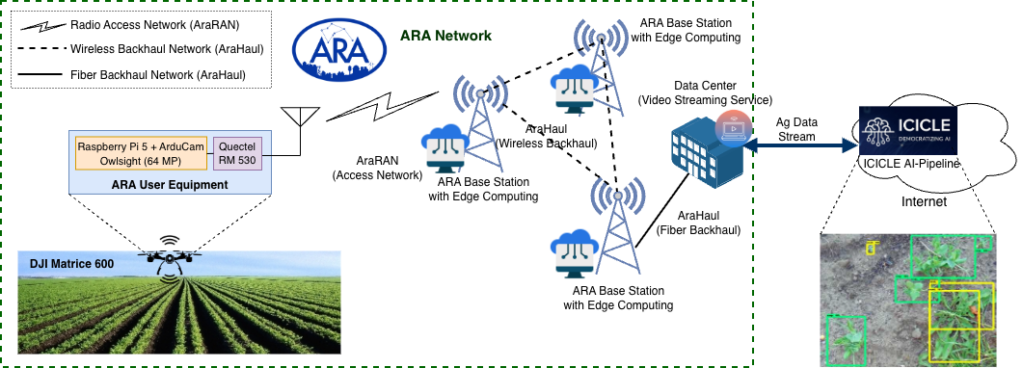
This demonstration is built around the ARA wireless network, which provides the connectivity between the field-deployed drone and downstream computing infrastructure, as illustrated in the figure below.. The drone carries an ARA User Equipment (UE) payload, consisting of an onboard compute node (Raspberry Pi 5 16GB RAM), a high-resolution camera (Arducam OwlSight 64 MP Auto Focus), and a cellular wireless module (Quectel RG530). As the drone flies over the soybean field, it connects to a nearby ARA base station and continuously streams video to the ARA Data Center through ARA x-haul links.

ARA-to-ICICLE architecture.

Rural deployments present unique challenges: unlike urban areas, base stations are often not connected by optical fiber. ARA addresses this limitation by providing long-range, high-capacity wireless backhaul (shown as AraHaul (Wireless Backhaul) in the figure above), leveraging technologies such as millimeter-wave, microwave, and free-space optical communication. This approach demonstrates that even fiber-scarce rural areas can be fully integrated into high-throughput AI pipelines, enabling real-time agricultural insights anywhere.

At the ARA Data Center, a dedicated video streaming server receives the incoming feed. ICICLE then retrieves the stream directly from this server for further processing and analysis.

ICICLE: Turning Remote Data into Actionable Insights

Once the video reaches ICICLE, the system generates individual frames from the live stream and geo-tags them using metadata embedded in the video. These processed frames are then fed into the ICICLE AI pipeline.

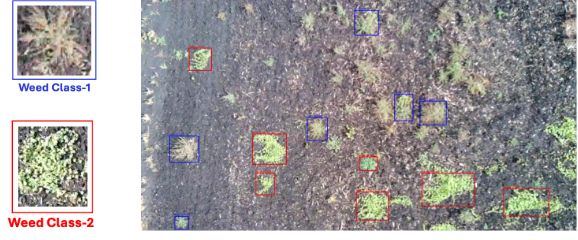
In our demo, we focus on weed detection, considering two weed classes. The AI engine analyzes the incoming frames and identifies weed regions, visually highlighting detected weeds for each class. Snapshots of weed detection results at ICICLE are shown in the figure below. This end-to-end workflow, from drone-based sensing to AI inference, demonstrates how remote agricultural environments can be tightly integrated with modern AI systems.

ARA-to-ICICLE: Weed detection snapshots.

Impact and Future Directions: Wireless and Agricultural Innovation Together

The ARA-to-ICICLE pipeline exemplifies a scalable, flexible framework for remote data sourcing in agriculture, providing:

  • Faster insights: Live streaming and real-time processing reduce the time from data capture to actionable recommendations.
  • Precision farming: AI-driven weed detection, crop health monitoring, and yield estimation support targeted interventions such as selective pesticide application.
  • Connectivity solutions for rural areas: Long-range wireless networks overcome infrastructure limitations, enabling AI adoption in remote fields.
  • Extensibility: Beyond weed detection, the system supports a wide range of applications including phenotyping, environmental monitoring, and precision crop management.

By combining ARA’s wireless infrastructure with ICICLE’s AI capabilities, this work illustrates how data-driven, responsive farming is possible anywhere, even in the most remote agricultural landscapes.

ARA December 2025 Newsletter Is Now Live!

We’re excited to share that the December 2025 ARA Newsletter is now available! This edition highlights ARA milestones, community insights, and the newest capabilities unlocked through the ARA wireless living lab. Highlights of this edition include:

  • Join us in September 2026 for AraFest 26! Co-located with the 2026 Farm Progress Show, AraFest’26 will showcase breakthroughs in advanced wireless technologies. Please join us to co-shape AraFest’26. Talks, panels, and demos are all welcome!  
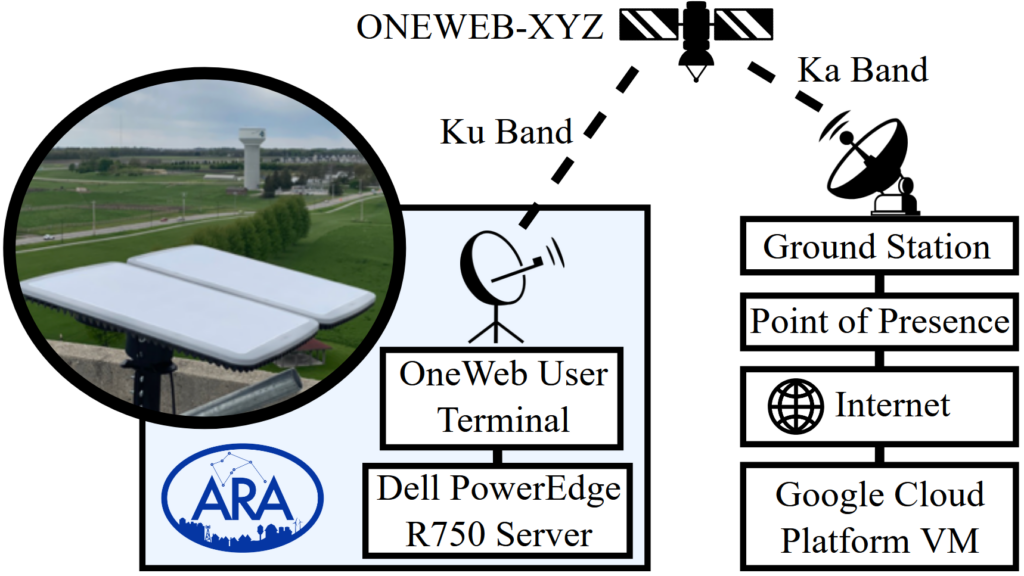
  • ARA capability update: A Starlink terminal has been installed next to the OneWeb user terminal. More experiments are supported by ARA , such as outdoor srsRAN experiments and OAI experiments at new outdoor sites.
  • User stories of how ARA can be used for 1) field scouting acceleration in precision agriculture and 2) random access reliability enhancement for NextG. 

“Amiga”: Accelerating Field Scouting with ARA’s FutureG Connectivity 

In the AIIRA national AI institute, Prof. Soumik Sarkar (Mechanical Engineering) and Prof. Asheesh “Danny” Singh (Agronomy) at Iowa State University leverages ARA to investigate how networked agricultural ground vehicles, remote sensing and computing, and machine learning can automate labor-intensive field scouting—transforming hours of manual assessment into near-real-time analysis and decision-making.

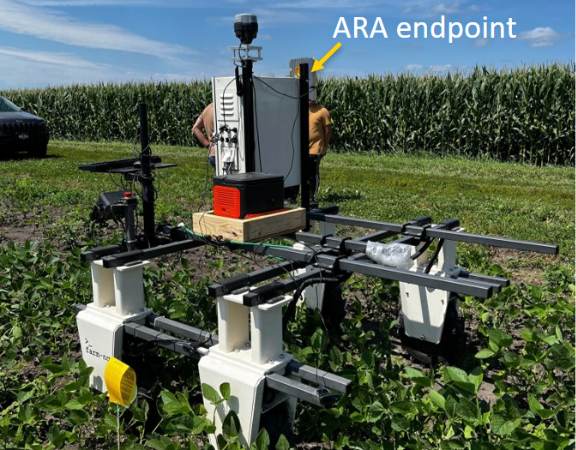
Traditional field scouting and crop phenotyping are both time-consuming and labor-intensive. To address this challenge, the team is developing an integrated platform (shown in the picture below) that combines a highly customized, field-deployable “Amiga” platform (Bonsai Robotics, San Jose, CA), which can be equipped with a wide range of sensors such as high-resolution imaging sensors, with an automated navigation system, an ARA communication user endpoint, and a high-performance computing unit. Together, these components enable automated data collection, fast model training, and data-driven actuation decisions directly in the field.

The ARA wireless living lab plays a key role in this initiative. The custom ARA communication endpoint developed for the Amiga robot delivers the throughput, coverage, reliability, and low latency needed for real-time video streaming, data collection, and edge inference, which is in sharp contrast to the unstable and intermittent connectivity commonly experienced in rural farm fields today. Joscif Raigne, a PhD student who manages and operates the Amiga experimental platform, shared his enthusiasm: “The sky is the limit for agricultural applications when unmanned vehicles, field sensors, and computing servers are interconnected through next-generation, reliable, high-performance networks.” 

The Amiga platform was featured as a plenary demo at AraFest’24. Videos of the presentation and demonstration can be found here. Currently, the team is expanding the pilot to include other types of unmanned agricultural vehicles, such as scouting drones and sprayer drones, for precision weed control and other farm applications.

Enhancing NextG Random Access Reliability in Programmable Wireless Living Labs

Author: Joshua Ofori Boateng 

The Center for Wireless, Communities and Innovation (WiCI) at Iowa State University has taken a significant step forward in improving the coverage and reliability of next generation random access (RA) procedure with the development of AraRACH: Enhancing NextG Random Access Reliability in Programmable Wireless Living Labs. By leveraging real‑world data from the ARA wireless living lab, they devised a slot‑based scheduling framework that reschedules RA messages into full downlink and uplink slots, unlocking all 14 OFDM symbols for each message to overcome reliability issues in large‑scale outdoor 5G/6G deployments. This work was recently honored with the Best Paper Award at the 2025 IEEE International Conference on Network Softwarization (NetSoft), and this work has enabled ARA to become the first-of-its-kind living lab for supporting open-source, whole-stack programmability in end-to-end 5G research and innovation from UE to gNB and Core.  

Open source 5G/6G software stacks such as OpenAirInterface (OAI) have unlocked unprecedented flexibility for 5G and next generation wireless research and innovation. However, at the core of this innovation is the performance in terms of coverage and reliability of these wireless living labs. For instance, interfacing power amplifiers and low noise amplifiers with software-defined radios (SDRs) for experimenting outdoors introduces issues in random access procedure—a process crucial in establishing connectivity between user equipment (UE) and the core network in 5G and 6G systems.  

Particularly, open-source 5G software stacks like OAI are faced with two major random access (RACH) procedure challenges in real-world and large-scale deployments–timing and reliability. In terms of timing, the RACH procedure fails due to the lack of precise TDD synchronization between the software stack and the amplifier within the special slot (S). For instance, the default OAI DL-UL switching occurs at the end of the last DL slot. However, as shown in Fig.1, the DL to UL switching gap must follow the last DL symbol within the special slot. Consequently, msg2 (a DL message) which is scheduled in a special slot fails to be transmitted due to amplifier being in the receive/uplink mode at the start of the special slot. This consequently causes the RACH procedure to fail. Also shown in Fig.1, OAI by default leverage a few symbols within the special or mixed slot to schedule msg2 and smg3. For instance, 6 downlink symbols and 4 uplink symbols are used to schedule msg2 and msg3 respectively. Such configuration causes the RACH procedure to fail over longer UE-gNB distances, consequently affecting reliability. We present AraRACH to jointly tackle both timing and reliability issues related to open source 5G RACH procedure. As shown in Fig. 2, AraRACH schedules RA response message (msg2) with a full downlink slot and radio resource control (RRC) connection request message (msg3) with a full uplink slot, granting each message access to all 14 OFDM symbols. This approach solves the timing issue which exists in the special slot, improves message coding rates by leveraging more OFDM symbols, and eventually improves msg2 and msg3 reliability over longer distances and under varying channel conditions.  

Fig.1: Default msg2 and msg3 scheduling in special slots
Fig. 2: Leveraging full DL and UL slots for msg2 and msg3

The ARA wireless living lab played a pivotal role in validating AraRACH. Spanning a 30 km‑diameter area in central Iowa and consisting of 7 software-defined radio gNBs and 30 UEs, including deployments in crop and livestock farms, grain bins, residential and industrial sites, ARA allowed real‑world experiments in both line‑of‑sight (LoS) and non‑LoS (nLoS) conditions. Researchers provisioned radio and compute resources via the ARA Portal and launched containerized OAI experiments for reproducible and scalable trials. 

Results demonstrated that AraRACH extends reliable 5G connection over unprecedented ranges: successful UE attachments were achieved at distances exceeding one mile, the longest to date using open‑source 5G software stacks on a programmable wireless living lab. Msg2 reception probability exceeded 90% whenever scheduled with at least eight to nine OFDM symbols, while msg3 reception probability remained above 80% even at one‑mile ranges when allocated eleven or more symbols.  

By proving end‑to‑end, open‑source 5G research and prototyping is viable in large‑scale outdoor environments, AraRACH lays a blueprint for improving the performance of open source 5G, 6G and open RAN field deployments worldwide. Future work will focus on automating SLIV selection based on in-situ channel conditions, extending the approach to emerging 6G RA schemes, releasing the AraRACH datasets and code to foster community-driven reproducibility, and contributing the source code of AraRACH back to the OpenAirInterface open-source community.  

Author’s Background 

Joshua Ofori Boateng is a Ph.D. candidate in Computer Engineering at Iowa State University and a graduate researcher at the Center for Wireless, Communities and Innovation (WiCI), where he works under Profs. Hongwei Zhang and Daji Qiao on the ARA platform. He co‑designed the ARA wireless living lab testbed, contributing to publications such as “Design and Implementation of ARA Wireless Living Lab for Rural Broadband and Applications” and “AraSDR: End‑to‑End, Fully‑Programmable Living Lab for 5G and Beyond.” Joshua holds a bachelor’s degree in Telecommunications Engineering from Kwame Nkrumah University of Science and Technology, Ghana, and his research focuses on open‑source NextG wireless platforms, Open RAN, and virtualization of software-defined radio platforms. To date, he has published 10 peer‑reviewed papers and has over 100 citations. 

Physics-Informed Neural Network for Radio Environment Mapping 

Author: Mukaram Shahid  

Prof. Hongwei Zhang and his team at Iowa State University (ISU) have made a leap in spectrum cartography with the development of ReVeal (Reconstructor and Visualizer of Spectrum Landscape), a Physics-Informed Neural Network (PINN) that enables high-accuracy Radio Environment Mapping (REM) using sparse data. This breakthrough, enabled in part by real-world data from the ARA rural wireless living lab, was recently reported at 2025 IEEE International Symposium on Dynamic Spectrum Access Networks (DySPAN). 

Accurate REM is critical for dynamic spectrum sharing, especially in environments where traditional methods fall short due to shadowing and lack of precise information about transmitters (e.g., location and transmission power) and the environment. For instance, traditional statistical channel models do not reflect the in-situ, specific terrain and environmental conditions; ray tracing tends to be computationally expensive and requires precise characterization of the complete propagation environment (e.g., vegetation, trees, buildings, materials), which tends to be difficult in practice. Spatial modeling techniques such as Kriging requires stationarity or dense sampling for optimal results, and existing neural networks tend to lack interpretability and do not leverage domain knowledge.  

The ISU team has introduced ReVeal, a novel PINN framework that embeds a physics-based partial-differential-equation spatial model of signal power into a neural network loss function. This approach allows ReVeal to: 

  • Accurately model wireless signal propagation with sparse data (e.g., only requiring 30 spatial sample points over an area of ~514 km² in the ARA wireless living lab), 
  • Function without requiring detailed transmitter information (e.g., location, transmission power), and  
  • Significantly outperform existing methods such as the statistical models used in 3GPP and ITU-R specifications, ray tracing, and neural networks without domain knowledge as shown in the figure below; the RMSE of signal power estimation is as low as 1.95 dB in ReVeal. 

The ARA Wireless Living Lab played a central role in the above study, and the dataset will be made available to the community soon. Researchers used ARA’s expansive, first-of-its-kind rural deployment in Iowa to collect real-world RSSI measurements over diverse terrains. The sparsity and heterogeneity of these measurements mimicked the real-world challenges spectrum regulators and dynamic users face in rural settings, making ARA the perfect proving ground for ReVeal. 

ReVeal’s performance highlights its potential to be a critical enabler for dynamic spectrum sharing, especially in underserved and rural regions. Its ability to reconstruct high-fidelity signal maps from minimal data makes it attractive for: 

  • TV White Space (TVWS) applications, 
  • Cognitive radio systems, 
  • Efficient interference management, and 
  • Potentially contributing to national spectrum policy and planning. 

The research team is now exploring the extension of ReVeal to dynamic environments with optimal spatiotemporal sampling and applying the approach to interference prediction, primary- and secondary-user coexistence management, and 5G/6G use cases. 

Author’s background: 

Mukaram Shahid is pursuing his Ph.D. from Iowa State University. He obtained his bachelor’s in electrical engineering from Ghulam Ishaq Khan Institute of Engineering Sciences and Technology, Pakistan, and his master’s in computer engineering from Iowa State University. His research focuses on topics covering Dynamic Spectrum Sharing, Spectrum Policy Enforcement, and AI & Machine Learning applications in wireless communications.