ARA-to-ICICLE: Remote Data Sourcing for Agricultural AI Processing

Authors: Sarath Babu, Vincent Lee, Joscif Raigne, and Hongwei Zhang (Iowa State University), Yatish S. M., Matt Lieber, and Hari Subramoni (The Ohio State University), and Martin Kandes (San Diego Supercomputer Center)

Modern agricultural AI relies on timely, high-quality field data. Yet collecting and processing this data in real time, especially in rural environments, remains a critical challenge. The ARA-to-ICICLE pipeline addresses this gap by enabling live agricultural data streaming from remote locations directly into an AI processing pipeline, unlocking faster insights and more responsive, data-driven farming.

This collaboration between the ARA project at Iowa State University, ICICLE at The Ohio State University, and the San Diego Supercomputer Center combines expertise in wireless networking, distributed systems, and AI-driven agricultural analytics, demonstrating how cross-disciplinary innovation can transform farming operations.

From a Soybean Field in Iowa to an AI Pipeline in Ohio 

Our demonstration focuses on a practical use case: monitoring a remote soybean field in Ames, Iowa, located at Iowa State University’s Agronomy Farm. A drone equipped with ARA wireless capabilities flies over the field, capturing high-resolution live video. Instead of storing the data for later analysis, the video is streamed in real time to the ICICLE AI pipeline at The Ohio State University, enabling immediate preprocessing and analysis. The live stream is broken into individual frames, geo-tagged, and processed for AI-driven tasks such as weed detection, allowing actionable insights to be generated in near real time. 

ARA Wireless: Enabling Edge Connectivity in Rural Environments

This demonstration is built around the ARA wireless network, which provides the connectivity between the field-deployed drone and downstream computing infrastructure, as illustrated in the figure below.. The drone carries an ARA User Equipment (UE) payload, consisting of an onboard compute node (Raspberry Pi 5 16GB RAM), a high-resolution camera (Arducam OwlSight 64 MP Auto Focus), and a cellular wireless module (Quectel RG530). As the drone flies over the soybean field, it connects to a nearby ARA base station and continuously streams video to the ARA Data Center through ARA x-haul links.
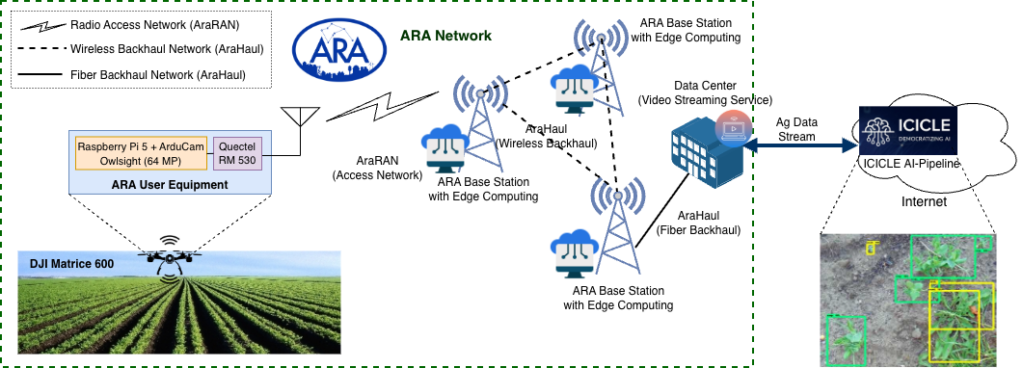
ARA-to-ICICLE architecture.

Rural deployments present unique challenges: unlike urban areas, base stations are often not connected by optical fiber. ARA addresses this limitation by providing long-range, high-capacity wireless backhaul (shown as AraHaul (Wireless Backhaul) in the figure above), leveraging technologies such as millimeter-wave, microwave, and free-space optical communication. This approach demonstrates that even fiber-scarce rural areas can be fully integrated into high-throughput AI pipelines, enabling real-time agricultural insights anywhere.

At the ARA Data Center, a dedicated video streaming server receives the incoming feed. ICICLE then retrieves the stream directly from this server for further processing and analysis.

ICICLE: Turning Remote Data into Actionable Insights

Once the video reaches ICICLE, the system generates individual frames from the live stream and geo-tags them using metadata embedded in the video. These processed frames are then fed into the ICICLE AI pipeline.

In our demo, we focus on weed detection, considering two weed classes. The AI engine analyzes the incoming frames and identifies weed regions, visually highlighting detected weeds for each class. Snapshots of weed detection results at ICICLE are shown in the figure below. This end-to-end workflow, from drone-based sensing to AI inference, demonstrates how remote agricultural environments can be tightly integrated with modern AI systems.
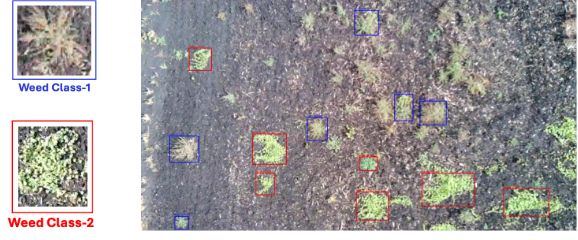
ARA-to-ICICLE: Weed detection snapshots.

Impact and Future Directions: Wireless and Agricultural Innovation Together

The ARA-to-ICICLE pipeline exemplifies a scalable, flexible framework for remote data sourcing in agriculture, providing:

  • Faster insights: Live streaming and real-time processing reduce the time from data capture to actionable recommendations.
  • Precision farming: AI-driven weed detection, crop health monitoring, and yield estimation support targeted interventions such as selective pesticide application.
  • Connectivity solutions for rural areas: Long-range wireless networks overcome infrastructure limitations, enabling AI adoption in remote fields.
  • Extensibility: Beyond weed detection, the system supports a wide range of applications including phenotyping, environmental monitoring, and precision crop management.

By combining ARA’s wireless infrastructure with ICICLE’s AI capabilities, this work illustrates how data-driven, responsive farming is possible anywhere, even in the most remote agricultural landscapes.

5G in Practice: Measuring Rural Wireless Technology for Edge Devices in Distributed Computation Workloads

Authors: Zack Murry (University of Missouri), Alicia Esquivel Morel (University of Missouri), and Kate Keahey (Argonne National Laboratory)

Introduction

As 5G networks expand beyond urban centers, it is also critical to understand how they perform in rural edge environments, where connectivity can be intermittent and infrastructure sparse. This project, conducted as part of the REU Summer Research Program at the University of Chicago, investigates whether mmWave 5G can reliably support distributed computation with real-world, resource-constrained devices. Unlike urban testbeds with dense infrastructure, rural wireless faces unique challenges. For instance, longer distances between radios, line of sight obstructions from crops or buildings, and limited backhaul capacity. These factors can make performance benchmarking difficult. This work also supports the broader goals of rural broadband initiatives and ARA’s “Bring Your Own Device (BYOD)” model, an approach that empowers researchers to deploy their own low-cost edge devices into an open, programmable testbed [1]. By using affordable and mobile hardware such as Raspberry Pi 4s in a rural context, we reflect a growing shift toward accessible, field-driven experimentation beyond traditional lab settings.

Research Objectives

Our goal was to understand how 5G wireless performs in support of real-time, distributed edge workloads. We asked the following questions:

  • Can we accurately measure latency between 5G-connected devices?
  • How does mmWave 5G impact throughput and processing time for distributed computation?
  • What is the effect of scaling the number of nodes on overall system performance?

By answering these questions, we hope to inform future deployments of edge-based applications in rural and remote environments.

Experimental Setup

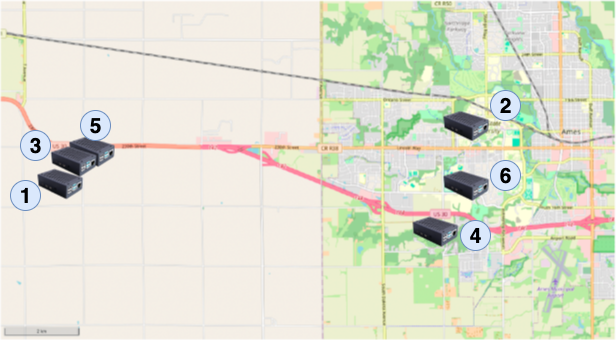
We deployed six Raspberry Pi 4 devices running FLOTO [2] through CHI@Edge [3] across a six-mile radius in Ames, Iowa, including research farms, and campus buildings. These devices were connected via ARA’s 5G mmWave and microwave radio infrastructure, using Aviat, Skylark, and USRP radios.

  • A GT-U7 GPS receiver for sub-microsecond time synchronization.
  • A custom Docker image for automated setup as a Hadoop master or worker node.
  • FLOTO application agents (running through CHI@Edge) to manage orchestration, telemetry, and logging.

The project leverages ARA’s BYOD capability, enabling external researchers to plug in and operate their own devices within a real-world rural wireless network. This modularity allowed us to experiment with lightweight infrastructure under conditions that mimic field deployments, where power, backhaul, and centralized compute resources are constrained. The devices self-organized into peer-to-peer Hadoop clusters, enabling us to run containerized TeraSort jobs without manual intervention. Raspberry Pi devices were distributed geographically in Ames, Iowa as shown in Figure 1. 

Figure 1: Deployment of FLOTO (Raspberry Pi) devices, geographically distributed in Ames, Iowa.

Results

GPS-Based Time Synchronization

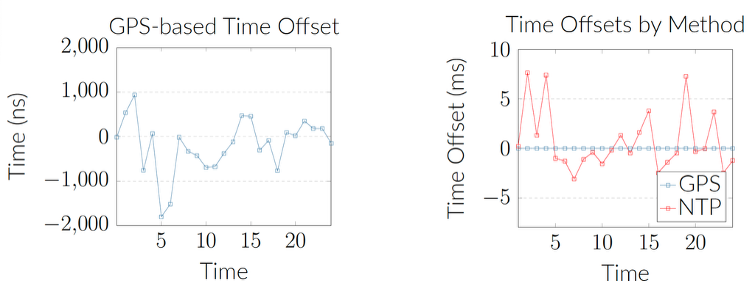
We compared GPS-based synchronization to standard Network Time Protocol (NTP). We found that GPS yielded 4,000× greater precision. This allowed us to accurately measure one-way latency between devices, something that is very difficult over wireless links.

Figure 2: Time synchronization accuracy, GPS vs. NTP

Network Performance

We measured latency and throughput across multiple device pairs. Performance was best when devices had clear line-of-sight to the 5G radios. Some links achieved up to 70.9 Mbps throughput with sub-millisecond latency. Table I describes the results in terms of the throughput and latency through different paths and distances.

PathDistance (mi)Throughput (Mbps)Latency (ms)
5 → 66.4470.90.70
3 → 26.5562.717.5
4 → 20.919.215.1
Table I: 5G network performance across rural testbed.

Distributed Computation Performance

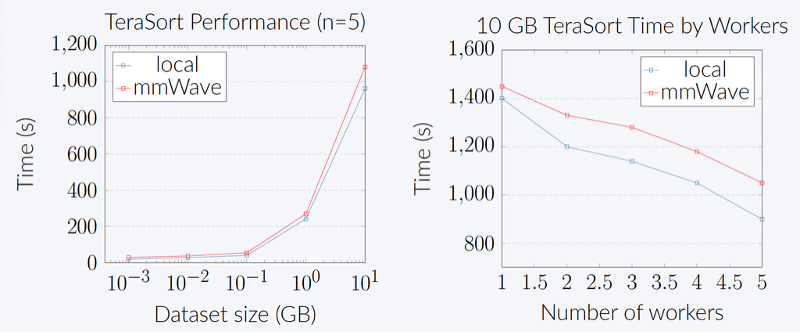
Using the TeraSort benchmark, we measured how long it took Hadoop clusters to sort datasets of increasing size. We compared performance across 5G-connected Raspberry Pis and wired connections.

Figure 3: TeraSort performance across dataset sizes and cluster sizes.

Key observations

  • 5G-connected edge nodes performed on par with wired nodes for small-to-moderate workloads.
  • As the number of nodes increased, performance per node slightly decreased due to HDFS synchronization overhead.
  • mmWave 5G links supported scalable, coordinated computation with minimal coordination delay

Conclusion

Our experimental results demonstrate promising accuracy in latency and throughput measurements, as well as the impact of mmWave 5G on throughput and distributed computation processing time. The findings also highlight the potential of rural 5G infrastructure to support edge computing applications on resource-constrained devices such as Raspberry Pis. By leveraging high-precision GPS synchronization, containerized workloads, and orchestration through the FLOTO application on CHI@Edge, we built a functional prototype of a wireless edge computing cluster. Our architecture was designed to align with rural broadband priorities while enabling local experimentation. A key objective was to support mobile and affordable hardware, thereby bridging the connectivity gap in underserved areas. ARA’s BYOD model further enabled evaluation under real-world conditions with minimal reliance on centralized infrastructure. These outcomes have promising implications for applications such as precision agriculture, rural sensing, and resilient field infrastructure.

What is next?

We are exploring several extensions to this work:

  • Comparing different 5G link types (e.g., mmWave vs. mid-band).
  • Testing mobile edge nodes (e.g., drones, buses, tractors).
  • Integrating alternative distributed computing frameworks (e.g., MR-Edge).
  • Adding energy monitoring and fault resilience features to the FLOTO application.

About the Authors

Zack Murry is an undergraduate researcher in Computer Science at the University of Missouri. He is interested in distributed systems, wireless networks, and field-based performance benchmarking.

Alicia Esquivel Morel is a Ph.D. candidate at the University of Missouri. Her research focuses on edge computing, fleet orchestration, and real-time IoT infrastructure.

Kate Keahey is a senior computer scientist at Argonne National Laboratory. She leads the Chameleon testbed and studies reproducible research infrastructure.

Acknowledgments

This work was conducted as part of the University of Chicago’s REU Summer Research Program. It was supported by the FLOTO project (NSF Award #2213821) and the U.S. Department of Energy, Office of Science (contract DE-AC02-06CH11357). We thank the ARA Wireless Living Lab for enabling experimentation in rural wireless environments.

This project was guided by mentors Alicia Esquivel Morel and Kate Keahey, who worked closely with REU student Zack Murry over the summer to design, deploy, and evaluate the system. The resulting work was accepted for presentation at the SC’24 Undergraduate Poster Research Competition in Atlanta, GA.

References

[1] Islam, Taimoor Ul, Joshua Ofori Boateng, Md Nadim, Guoying Zu, Mukaram Shahid, Xun Li, Tianyi Zhang et al. “Design and implementation of ARA wireless living lab for rural broadband and applications” Computer Networks 263 (2025): 111188.

[2] “FLOTO | Center for Broadband Research.” Accessed September 16, 2025. https://floto.cs.uchicago.edu/

[3] Keahey, Kate, Michael Sherman, Jason Anderson, and Mark Powers. “CHI@ Edge: Supporting Experimentation in the Edge to Cloud Continuum” In Practice and Experience in Advanced Research Computing 2025: The Power of Collaboration, pp. 1-8. 2025.