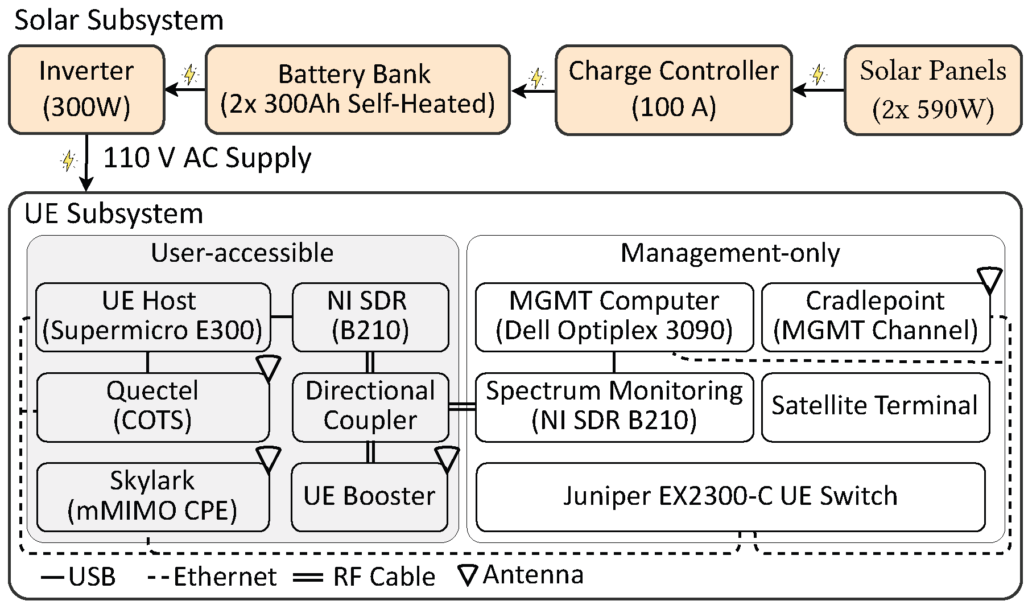
What if cutting-edge 5G and 6G research could happen anywhere, even in the middle of a farm with no electricity? AraROAM makes that possible. Developed as part of the ARA Wireless Living Lab at Iowa State University, AraROAM is a portable, solar-powered user equipment (UE) station that enables advanced wireless experimentation in remote rural environments. As shown in Figure 1, it combines commercial 5G, software-defined radio (SDR), and massive MIMO technologies into a single mobile platform, bringing the wireless lab directly to where future applications will be deployed.
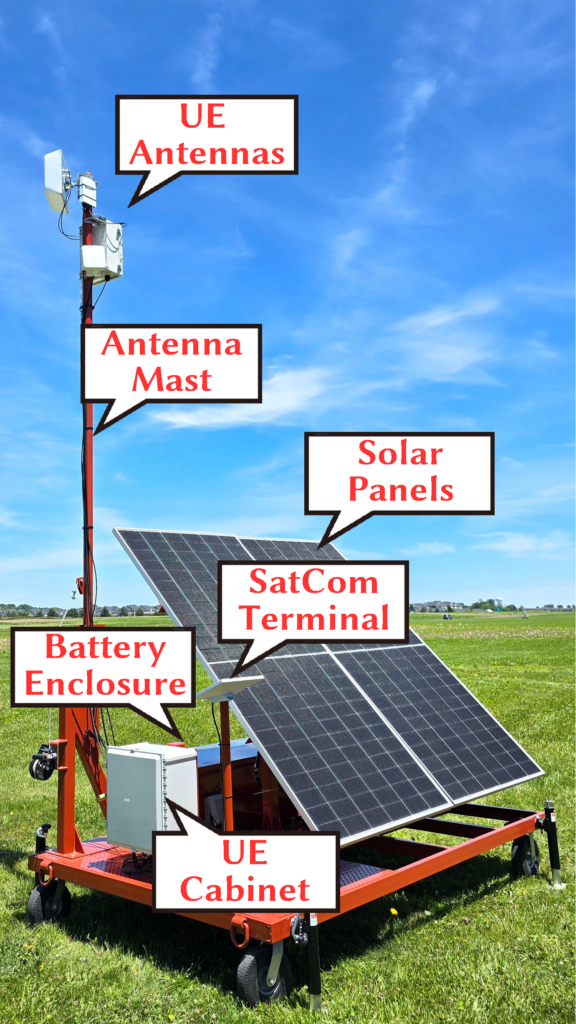
Built for year-round off-grid operation, AraROAM integrates high-efficiency solar panels, a large self-heated battery bank, onboard computing, and intelligent power monitoring into a rugged trailer, as shown in Figure 2. Its foldable antenna mast and remote management capabilities enable fast, flexible deployment for wireless experiments in remote rural environments. The platform continuously monitors solar generation, battery health, and system power consumption while supporting multiple wireless technologies, enabling researchers to evaluate both communication performance and energy efficiency under real-world conditions. The AraROAM power monitoring APIs have been released as open-source software on GitLab.
Field trials demonstrate that AraROAM provides reliable, sustained off-grid operation while supporting diverse wireless experiments across commercial and open-source 5G networks. The platform can operate continuously for more than three consecutive days, even under overcast conditions. By eliminating the dependence on grid power, AraROAM opens new opportunities for research in precision agriculture, autonomous systems, rural broadband, and next-generation wireless networks, accelerating innovation where connectivity is needed most.